"Writing in (& about) the Age of Artificial Intelligence"
Syllabus
Fall 2023
"Science into Fiction"
Writing Workshop Series #3
syllabus complete - v.1.11, November 28
Goals
& Overview
If our era is the next Industrial Revolution, as many claim, AI is surely one of its driving forces.
- Fei-Fei Li
Artificial intelligence (AI) has played an important - even central - role in
speculative literature for generations. It's already beginning to impact our
daily lives, and will soon dominate every aspect of human experience. This
workshop will not only help you develop, write, and revise a new short story, it
provides the foundations of understanding what AI is, its current state of
development, and where it might be headed.
To reach these goals, we'll read articles and watch media about the state
of the art in AI and spec-fic writing, study fiction and film that
dramatizes the future of AI, and maybe even experiment with chatbot writing tools.
We'll watch talks by AI experts to help stimulate ideas,
hold a weekend of story-development and brainstorming sessions, and draft a
new story over the next six weeks. All during the story-drafting period, we'll hold
weekly online discussions and writing-support groups, and
stay in touch to share ideas, cool stuff to read and watch, and to offer
support. After a week to read and critique everyone's stories, we'll hold a
weekend critique workshop to help get your story in condition to submit for
publication.
At the end of this workshop, you'll have a completed story about
what is perhaps the most-important topic of our time, and you'll be
better-informed than most folks. This is what "Science into Fiction" is all
about!

Everyone comments on every story, we analyze each story for publishability,
and encourage writers to submit their work for publication.
My philosophy of writing workshops:
Through applying effort, drive, and passion - and mastering the fundamentals - anyone can become a published author.
We'll work to
demythologize the artistic process by breaking it down into everyday acts anyone can
learn to do. You don't need to be touched by some angel of creativity to become an
author, though this kind of opinion still prevails among certain literary elitists as well as in primary and secondary schools, where talent is immediately visible.
You can write successful stories if you learn the tools, elements, and theory, and
put what you learn into practice by writing and revising what you write.
To accomplish this, we'll break down the creative act into things we can
discuss. Any complex action is only understandable if you break it down into smaller segments.
During this workshop, in addition to getting a solid grasp of AI, you'll learn to write engaging short stories by
studying successful works and mastering the elements of
speculative-fiction writing. In our discussions we'll cover a wide range of
subjects including character, dialogue, idea generation, micro-writing,
openings, plot, point of view, scenes, setting, structure, voice, publication
strategies, and more. We'll also practice editing by critiquing each other's
work,
because mastering revision is the only way to improve our writing.
In addition to science fiction, we welcome fantasy, horror, magical realism, and other genres
- this topic might inspire ideas about other forms of non-human intelligence,
raise ethical issues about creating beings only to serve, and so forth.
Readers have varying expectations, so we'll discuss those, as
well.
I encourage participants to remain
in regular contact, continuing participation in our Discord channel, future workshops and write-ins,
and supporting one another's writing careers, even continuing to critique
one another's work. Attendees have many opportunities to socialize with one another
live and online, and
many build life-long relationships enhanced by our social connectivity. The AdAstranaut experience is more than an
eight-week, two-weekend
live and online adventure - it's a community!
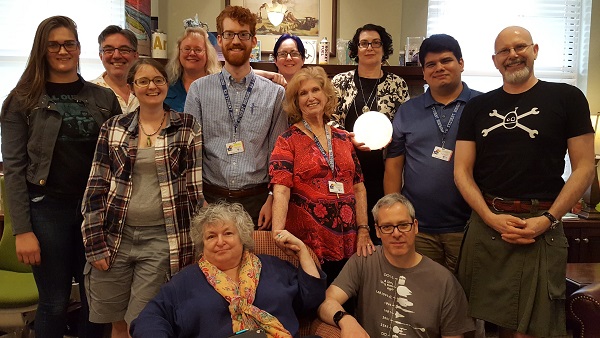
McKitterick's 2018 Spec-Fic Workshop cohort.
Sitting: Pat Cadigan,
Julian Richardson. Standing, left to right: Achilles Seastrom, Jean Asselin,
Mary Fluker, Kathy Kitts, Theodore Nollert, Sarah Worrel, Patricia Crumpler,
Sanna Breytberg, Ian Martinez-Cassmeyer, Chris McKitterick.
Instructors

Christopher McKitterick
Workshop Leader
Award-winning author, educator, and
Ad Astra director
Chris McKitterick leads the workshop. He'll participate from when the application
period opens through the end of the cycle, helping brainstorm and critique every
story and giving short talks on writing. He hopes to host an expert guest during
the AI Workshop to help answer Q&As.
Chris has taken writing and science
workshops across the country since the 1980s, and first took James Gunn's
Science Fiction Writers Workshop in 1992, then served as guest instructor from
1995-2009, leading the redesigned
Spec-Fic Workshop since 2010.
In 2016 he founded the
"Repeat Offenders"
Speculative Fiction Writing Workshop (advanced workshop for returning alums),
and the Ad Astra "Science into
Fiction" Workshop series in 2022.
Since the 1990s, he has taught science-fiction and creative-writing workshops,
seminars, masterclasses, and full-semester courses at the University of Kansas
and around the world. In 2018, he was one of three finalists for the
H.O.P.E.
(Honor for Outstanding Progressive Educator) Teaching
Award, the most prestigious teaching award given at the University of Kansas.
Chris' short work has appeared in many publications. His "Ashes of Exploding Suns, Monuments to Dust"
made the Tangent Recommended Reading List and won the AnLab
Reader's Award for best novelette - his first major fiction-writing
honor. He regularly publishes
nonfiction, and a
poem or two became
lyrics for songs. His debut novel, Transcendence, is
in its second edition. He recently finished a couple more novels, Empire Ship
and the first book of
The
Galactic Adventures of Jack and Stella, and has several other projects on the burners.
En route to becoming an SF scholar, writer, and educator, Chris studied
astrophysics, education, classics, and psychology. He earned his BA in creative writing
from the University of Wisconsin-Eau Claire, where he ran two observatories and
a planetarium and served as assistant instructor for physics and astronomy
courses. He spent a year teaching K-12
school in the Montana Badlands, then began formal SF writing and literature
studies in 1992 with James Gunn at the University of Kansas, where
he earned his MA in creative writing and continued post-graduate studies
ever after. He's taken For nearly a decade, he worked for gaming and tech companies in
Seattle, spending summer vacations co-teaching the
SF Workshop and
SF Institute.
In 2002, KU recruited him to teach SF and writing full-time, where he developed
many offerings. He
never stops learning, including at
The
Schrödinger Sessions quantum physics workshop and the
LaunchPad Astronomy Workshop.
Chris first launched Ad Astra as a
KU Center (announcement)
in 2021 after having directed James Gunn's original Center for the Study of Science Fiction
with Jim and Kij Johnson from 1995-2022, then expanded it into the non-profit Ad Astra
Institute for Science Fiction & the Speculative Imagination in 2023. In
addition to doing all things Ad Astra, he rescues wild animals, lives with many
beloved critters, gardens, and watches the sky. He's also getting married to his
beloved Lauren right before we begin!
Read more about
Chris here (formal bio), or
here (less formal), or hang out with him online:
Facebook | Instagram | Tumblr | Xitter | YouTube | Christopher-McKitterick.com

Special Guest Instructor
Phil Baringer

We are privileged to announce that experimental particle physicist and science-fiction expert
Phil Baringer joins us as Special Guest Instructor
for the workshop!
Philip Baringer, PhD, has more than 35 years of teaching and research experience. He's Professor Emeritus of Physics and Astronomy
who's received numerous awards for his teaching, including the Department Undergraduate Teaching Award, the Kemper Award for Teaching
Excellence, and the University Center for Teaching Excellence (CTE) Excellence in Teaching Award, chosen by graduate students
in Physics and Astronomy. He served as inaugural speaker for Ad Astra's
Science into Fiction writing workshop
series, also participating in the developmental and critique workshops, where he
not only shared his scientific expertise but also a deep understanding of SF
narrative. For the 2023, Phil served as Special Guest Instructor for the
summer
Speculative Fiction Writing Workshop and
"Repeat Offenders" Workshop. For nearly 20 years, Phil has co-taught "Science,
Technology, & Society: Examining the Future Through a Science-Fiction Lens"
with McKitterick, taught several science-fiction Honors courses at KU, served
on many graduate thesis and dissertation committees on SF writing and
literature, serves on the nominations committee of the
Theodore Sturgeon Memorial Award for best short SF, and is a ravenous SF
and comics reader.
Baringer's research focuses on experimental particle physics, particularly production of the top quark. He is
a member of the Compact Muon Solenoid collaboration, an international group operating an experiment at the European Organization
for Nuclear Research's Large Hadron Collider.
Baringer believes in the importance of communicating science to a general audience.
He has also received the Steeples Award for Service to Kansans, an award that recognizes faculty members for sharing their teaching and research with the people of Kansas.
Phil will participate in most of the discussions plus will join for the
two weekend events to provide a
fresh perspective on your story development and revision.
Read more about Phil on
his
KU bio page, LinkedIn,
or
Google Scholar.
Discussion Schedule
Weekly Discussion Reading & Viewing Topics
We are on the edge of change comparable to the rise of human life on Earth.
- Vernor Vinge
For our developmental-session and brainstorming weekend (October 21-22),
as well as for our critique weekend (December 9-10), we'll gather in-person
and in our Discord live-video room. Finished draft of story is due to the group by December 1.
The overall schedule for our Fall 2023 "Science into Fiction" workshop on artificial intelligence,
at a glance:
Quick Schedule
- Application window - now closed: August 28 - October 17.
- Read & watch assigned materials: August 28 - December 1.
- Discuss assigned materials: Weekly(-ish) October 18 -
December 1, 7:00pm -
9:00pm (USA Central Time) via the Ad Astra Discord
server's "adastranauts-voice-and-video" channel just for this workshop.
- Story-development and brainstorming weekend: October
21-22, 1:00pm - 6:00pm (USA Central Time) both days, hybrid in-person and via
the Ad Astra Discord server's "adastranauts-voice-and-video" channel.
- Story draft due to all participants: December 1.
- Final critique weekend: December 9 - 10, 1:00pm -
6:00pm (USA Central Time) both days, hybrid in-person and via the Ad Astra
Discord server's "adastranauts-voice-and-video" channel.
Most weeks we'll gather on Discord to discuss that week's assigned materials.
No one will get an "F" for not reading or watching the assigned (or bonus)
materials, of course, but use this unique opportunity to not only write and
critique a story, but get a firm understanding of the technology that is likely
to completely reshape our lives in the very near future.
So here's what we'll talk about while working on our stories. Below you'll find a detailed syllabus of weekly reads and media to enrich your understanding of AI and related topics -
please read and watch all of these (and write your responses) to prepare for our group discussions.
A few bonus books are recommended for our final few discussions -
The Age of Spiritual Machines, by Ray Kurzweil
(also available as a free
.pdf);
Accelerando,
by Charles Stross (available to
read free on Stross' website);
Neuromancer, by William Gibson; and Rapture of the Nerds
(2012), by Cory Doctorow and Charles Stross (also free online at Stross' website);
plus a few large websites - so if you'd like to take a deep-dive and get
ahead of the readings to focus on your story draft during those weeks, dive in now!
Most assigned readings and viewings are pretty short.
Detailed
Weekly Schedule
Week 1: October 18
What is artificial intelligence?
Readings
- "What is artificial intelligence?"
by Dr. Peter Bentley for the BBC's Science Focus.
- "Difference Between Machine Learning and Artificial Intelligence,"
by Anusha Sharma for the GeeksForGeeks autodidact community. Includes
links to lots more info.
- "The AI Revolution: The Road to Superintelligence"
(part 1), by
comic artist Tim Urban for his WaitButWhy blog - a brilliant and
accessible piece.
- Fiction: "Silently and Very Fast," by Catherynne M. Valente (three
parts - October, November, and December 2022,
Clarkesworld, short novelette). Nominated for the Hugo, Nebula,
Sturgeon, and World Fantasy Awards; won the Locus Award.
Watch
Bonus!
This syllabus includes lots of bonus recommendations, but here are some
items especially for this week:
Weekend Workshop: October 21-22
* Story-development brainstorming sessions! *
Bring your ideas for the story you'd like to write over the next several
weeks, and come prepared to help develop everyone
else's stories during our brainstorming weekend!
For the live developmental sessions, we'll focus on helping develop your
project rather than perform traditional critiques, so it'll be more
free-form than during the final critique weekend. To help everyone focus,
let us know in advance if your work is pretty well underway or if you're at
the "throwing everything at the wall to see what sticks" stage. Depending on
how many are doing that, we'll alternate between traditional round-robin
workshopping and free-form developmental sessions.
I put together
this detailed set of guidelines for developmental sessions - check it
out to get an idea of how to make the most of this weekend. As for
brainstorming, well, you probably know what that entails, but in short:
There's no bad ideas during brainstorming; the idea is to dump out as many
ideas and ask as many questions as possible in order to come up with your
best set of ideas and put together a story outline, character sketch,
worldbuilding, and so forth.
I've been writing and collecting
speculative-fiction writing resources for decades, so take advantage of
those materials! Tons and tons.
We'll meet live both in-person (in Lawrence) and online via our Discord
channel (enrollees will get details in advance). If you're joining us
remotely, please make sure in advance that you have a good microphone and
speaker setup (or headset), and that you're set up with Discord; a good camera and screen is nice,
too.
Week 2: October 25
Robots & AI in our lives
Not part of the workshop, but a quick announcement: World Fantasy begins tomorrow! If you're in the Kansas City area,
take advantage of this major convention being in our neighborhood.
Readings
Interact with some chatbots
-
Bing, Microsoft's chatbot, is currently considered by many to be the best at
chatting - it's a search engine after all!
-
ChatGPT, OpenAI's chatbot.
Currently the most famous of
what used to be called, "chatterbots." This one answers questions (though it's famous for making
stuff up), (sort of) writes stories, (sort of) produces essays (if you don't mind
"hallucinations"
aka lies), and even writes code. ChatGPT is so sophisticated that it's helping people start to
imagine the true potential of AI and how, for better or for
worse, it can change our daily lives and even define humanity's future. A free version of ChatGPT (GPT-3.5)
is available for anyone to use on the ChatGPT website. All you have
to do is sign up to get a login, and you can be mining the depth of
the AI model in seconds. A free version of ChatGPT is also available
on Android and Apple devices. A more advanced version of ChatGPT,
known as ChatGPT-4, is also available, but only to paid subscribers.
Bonus!
Some recommended extra items especially for this week:
- Episodes of the tourist robot trio in the Netflix original anthology series,
Love, Death, + Robots
(2019-on, mostly animated).
- "Chatbots sometimes make things up. Is AI's hallucination problem fixable?" by Matt O'Brien for AP News.
- "The End of High-School English: I've been teaching English for 12 years, and I'm astounded by what ChatGPT can produce,"
by Daniel Herman for The Atlantic.
- "I asked ChatGPT, Bing, and Bard what worries them. Google's AI went Terminator on me," by David Gewirtz
for ZDNET.
- "What Are Bob and Alice saying? [Mis]communication and Intermediation Between Language and Code,"
by Hannah Lammin.
Natural language interfaces enable intuitive conversational interactions with computational devices, while rendering the inner workings of these technologies opaque. However, such interfaces can also produce events of miscommunication between computers and their human users, which draw attention to the nonhuman logic operating inside the black box. This essay examines one such instance of miscommunication: the case of "Bob" and "Alice," a pair of chatbots developed by Facebook that were shut down in 2017 because they started conversing in a language of their own.
- This Brain-Like IBM Chip
Could Drastically Cut the Cost of AI, by Shelly Fan.
- Following the success of OpenAI's ChatGPT, Google released its own AI chatbot,
Bard, now widely available (via
ZDNET).
- Fiction:
Neuromancer, the classic cyberpunk novel by William Gibson. A readable copy (barely) is available to
borrow free (renewable every
hour, pending availability) on the Open Library Internet Archive (free registration required).
They also host a wonderful audiobook read by Gibson himself!
(For more AI-related novels, see the list of recommendations, below.)
- Check out some of my ever-growing curated
playlists
of short SF films on YouTube, including:
- You might also like to check out some of my curated Tumblr blog's
science fiction tags, specifically:
Week 3: November 1
What's "state of the art" in artificial intelligence?
Readings
- "10 Graphs That Sum Up the State of AI in 2023," by Tekla S. Perry for
IEEE Spectrum.
A fascinating read, boiling down the 300-page
Stanford AI Index Report
into easy to understand infographics with short descriptions, tracking breakthroughs, training costs, misuse, funding, and more.
- "AI-art isn't art: DALL-E and other AI artists offer only the imitation of art,"
by Eric Hoel for his The Intrinsic Perspective blog.
- Fiction: "Murder
by Pixel: Crime and Responsibility in the Digital Darkness," by S.L.
Huang (December 2022 Clarkesworld, short novelette). Up for the 2023 Nebula and Ignyte Awards, among others. Like most
Clarkesworld stories, there's also an
audio version.
Watch
Bonus!
This week's recommended bonus items to level up your grasp of AI.
- "Meta unveils AI assistant, Facebook-streaming glasses," by Katie Paul and Anna Tong for Reuters.
The end of privacy as we know it?
- The Stanford University 2023 AI Index Report.
The AI Index is an independent initiative at the Stanford Institute for Human-Centered Artificial
Intelligence, led by the AI Index Steering Committee, an interdisciplinary group of experts
from across academia and industry. Perhaps the best, most independent,
and most detailed look at AI you'll find - and at more than 300 pages,
it ought to be. This annual report tracks, collates, distills, and visualizes
data relating to artificial intelligence, enabling decision-makers to take meaningful action to
advance AI responsibly and ethically with humans in mind.
-
USA Department of State's report on AI.
Governments have
become deeply invested in AI - here's what the USA currently thinks
about it, with tons of references and downloadable documents that detail
things like the new multinational agreement about limiting AI in
warfare.
- "State of AI Report 2022,"
by Nathan Benaich and Ian Hogarth.
What's the current state of AI, and how
has it met industry predictions? This massively detailed online
presentation analyzes the most interesting developments in AI, seeking to
trigger an informed conversation about AI and its implications for the future.
Interesting in that this is business-focused as opposed to the US State
Dep't report.
- Fiction: "Supertoys Last All Summer Long"
(Harper's Bazaar, 1969) - because this space needed some fiction!
- Check out some of my ever-growing curated
playlists
of short SF films on YouTube, including:
- You might also like to check out some of my curated Tumblr blog's
science fiction tags, specifically:

Week 4: November 8
Ethics & artificial intelligence
Readings
- "Ethical Issues in Advanced Artificial Intelligence,"
by Nick Bostrom.
The ethical issues related to the
possible future creation of machines with general intellectual
capabilities far outstripping those of humans are quite distinct from
any ethical problems arising in current automation and information
systems. Such superintelligence would not be just another technological
development; it would be the most important invention ever made, and
would lead to explosive progress in all scientific and technological
fields, as the superintelligence would conduct research with superhuman
efficiency. To the extent that ethics is a cognitive pursuit, a
superintelligence could also easily surpass humans in the quality of its
moral thinking. However, it would be up to the designers of the
superintelligence to specify its original motivations. Since the
superintelligence may become unstoppably powerful because of its
intellectual superiority and the technologies it could develop, it is
crucial that it be provided with human-friendly motivations. This paper
surveys some of the unique ethical issues in creating superintelligence,
discusses what motivations we ought to give a superintelligence, and
introduces some considerations relating to whether the development of
superintelligent machines ought to be accelerated or slowed.
"What are
AI-generated deepfakes, and how can you spot them?" by The Guardian.
- Fiction: "The Evitable Conflict,"
by Isaac Asimov (June 1950 Astounding, short story [.pdf]). The
much-reprinted classic story that added the "Zeroth Law" to the
Three Laws of Robotics
and inspired the I, Robot movie.
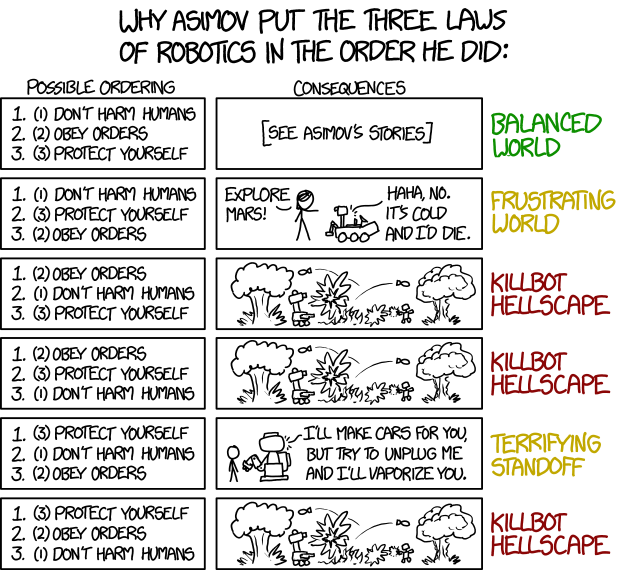
- Asimov's Laws of Robotics:
- Law One: A robot may not injure a human being or, through inaction, allow a human being to come to harm.
- Law Two: A robot must obey orders given to it by human beings except where such orders would conflict with the First Law.
- Law Three: A robot must protect its own existence, as long as such protection does not conflict with the First or Second Law.
- The "Zeroth Law" (takes priority over the others, added later):
A robot may not harm humanity, or, by inaction, allow humanity to come to harm.
Watch
Bonus!
Some
recommended extra items especially for this week.
- Fiction: "I, Robot," by Cory Doctorow
(April 2005 The Infinite Matrix, long novelette). A direct response to Asimov, among others.
Won the 2005 Locus Award and was a finalist for the Hugo and British Science Fiction Awards.
Also on
Doctorow's website with Creative Commons license and author commentary.
- The short animated series,
The
Animatrix - all available to watch online here. It's the
prequel to
The Matrix (also by the Wachowskis), setting up
the origin of the conflict between humans and AI.
- BBC Radio's production of "The
Evitable Conflict," the final episode of a five-part 15-Minute Drama adaptation of Asimov's
I, Robot series.
- Check out some of my ever-growing curated
playlists
of short SF films on YouTube, including:
- You might also like to check out some of my curated Tumblr blog's
science fiction tags, specifically:
Week 5: November 15
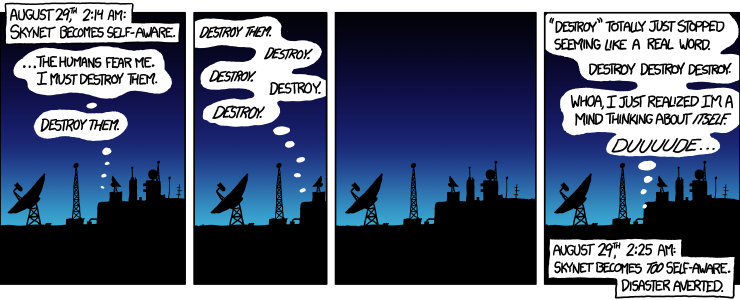
Terminator, Skynet, & agents of The Matrix: Killer 'bots
Readings
Watch
-
UNKNOWN: Killer Robots
(2023) - Netflix original documentary about how AI is already being
implemented in killing machines and how it might soon dominate war,
including creating weapons of mass destruction (no robot sentience or malice required).
- If you haven't watched
The
Terminator (1984), now's the time!
- Similarly, if you haven't watched The Matrix
(1999), this is a great week for it.
Bonus!
Some recommended bonus items especially for this week:
-
Battlestar Galactica (2004-2009), the recent
series.
-
Ghost in the Shell (1995), based on the Japanese
seinen (adult) manga,
Mobile Armored Riot Police.
There's also a recent live-action version of the film that
brings up problematic aspects of Hollywood.
-
Raised By Wolves (2021-), the HBO Max original series about two
androids raising the last human children on an alien planet.
- The Sarah Connor Chronicles (2008-2009) is
a great spinoff series in the Terminator universe that follows the life of
John and Sarah Connor between the movies.
Level up your killer 'bot background with more of the
Terminator movie saga, still going strong.
- Fiction: "With Folded Hands,"
by Jack Williamson - the original robot-laws-gone-amuck story, which
inspired Asimov to come up with less-problematic rules.
- Check out some of my ever-growing curated
playlists
of short SF films on YouTube, including:
- You might also like to check out some of my curated Tumblr blog's
science fiction tags, specifically:
no week 6 discussion: Holiday break
- see you next week! -
No assigned materials or online discussion
during Thanksgiving week, but feel free to hang out in our Discord!
But since you're here, why not watch "The Last Bastion,"
a bittersweet video about a battle-robot rebooting in a forest (short animated video for the Overwatch game).
Week 7: November 29
The Technological Singularity
What's the ultimate form of AI, and how will Artificial General
Intelligence (AGI) utterly transform human existence?
Readings
- "The AI Revolution: Our Immortality or Extinction"
(part 2), by
comic artist Tim Urban for his WaitButWhy blog - the second part of his brilliant and
accessible piece, this time looking at what might become of the world
when/if we achieve AGI. Includes some
side-notes about nanotechnology.
- Vernor Vinge's essay, "What
is the Singularity?" which links to lots
more info about the technological singularity.
- "Singularity: Explain It to Me Like I'm 5 Years Old,"
by Roey Tzezana for Futurism.com.
- Fiction: "Lobsters" (Asimov's
SF Magazine, June 2001), by Charles Stross. Finalist for the
Hugo, Nebula, and Sturgeon Awards.
This short novelette is the first of nine stories that comprise the 2005 novel,
Accelerando, available to
read free on Stross' website. The novel won the 2006 Locus Award for Best Science Fiction Novel and was a finalist for several others.
- "Humanity May Reach Singularity Within Just 7 Years"
(published in 2023), by Darren Orf for Popular Mechanics.
- The Encyclopedia of SF's
"Singularity" entry
- more about the Technological Singularity in SF than a scientific background.
Watch
- Her (2013).
A quiet and lovely look at one possible Technological Singularity
moment.
Bonus!
Some recommended level-up items especially for this week:
- "This Is the Speed at Which We Are Approaching Singularity in AI,"
by Translated.
-
The Age of Spiritual Machines, by Ray Kurzweil
(book, available as a free
.pdf here).
This visionary and creative
work of speculative nonfiction offers a vision
of the marriage of human sensitivity and artificial intelligence that
will fundamentally alter (and, in his opinion, improve) the way we live.
Kurzweil's prophetic blueprint for the future takes us through the advances that inexorably result in computers exceeding the memory capacity
and computational ability of the human brain very soon. Published 20
years ago, Kurzweil's predictions are looking pretty darn close to
becoming reality. A must-read for anyone looking for how we might
develop relationships with automated
personalities as our teachers, companions, and more, and how AI is
likely to change the human experience. I would make this required
reading, except it's, y'know, a whole book.
- "DeepMind's
Newest AI Programs Itself to Make All the Right Decisions," by Jason Dorrier for
Singularity Hub. Being able to program itself is a major leap forward in artificial intelligence, and a huge step toward the Technological Singularity:
When AGI can program itself, new generations of AI will appear in not years or months, but hours or even milliseconds.
- Fiction: Rapture of the Nerds
(2012), by Cory Doctorow and Charles Stross.
Whole book is also free online at Stross' website.
A tour de force
by two of the foremost SF writers in this topic, each battling to
see who can be the cleverest. Wonderful look at a post-Singularity,
posthuman world.
- "Data's Dreams" episode of
Star Trek: The Next Generation (much of the show -
especially where Data is involved - is relevant). What goes on in
the sleeping mind of a sentient AI?
- Check out some of my ever-growing curated
playlists
of short SF films on YouTube, including:
- You might also like to check out some of my curated Tumblr blog's
science fiction tags, specifically:
December 1
* Completed draft of your story due to the group today *
Send your story to everyone in the workshop by the 1st of December so we have time to
give it a good read and write up our critiques over the next week.
Clean up any mechanical issues (formatting, spelling, grammar, and so
forth) before you submit your work, and use professional manuscript
format as if you're submitting to a publisher. Here's
a great example (follow it!). Here's
another piece on "Manuscript Preparation" (pdf), by Vonda McIntyre.
Practice looking like a pro now (plus it'll make everyone's lives easier).
When you start seeing stories, dig in right away!
Weekend Workshop: December 9-10
* Story-Critique Sessions! *
Now we launch our championship weekend!
We'll gather in-person in
Lawrence, Kansas, and simultaneously via our Discord
livestream channel to critique everyone's stories.
As soon as your cohort's stories begin appearing in our group, give them
a read to see what the author is trying to do, then write a solid critique. Feel free to
mark up typos, punctuation, and grammar issues, but for time's sake,
please don't bring up those details during our live discussion.
Primarily, your goal is to identify the "Platonic ideal" of the story and
then suggest ways to help the author achieve that ideal. I put together
this
outline of the process that I urge you to read now:
https://adastra-sf.com/Workshop-stuff/Critiques-and-Discussions.htm
Here's another in-depth critiquing page I created for my KU writing
students, which goes into greater detail - perfect if you've never done
workshopping before.
For these final critique sessions, we'll use the process I've found
most useful over the years:
After everyone has read and critiqued your cohort's
stories in advance, we'll discuss them in a round-robin format, and I'll offer my thoughts last,
usually with a short talk on relevant aspects of writing.
Before we begin, I
encourage the stories' authors to ask specific questions they'd like us to address, and
after each set of critiques we'll hold a short open discussion.
I prefer this process over
random discussion or lectures because writers learn at least as much from critiquing
one others' stories as from hearing critiques of their own work. It also makes for a much
more interactive, lively, and involving discussion for all.
We'll also analyze each story for publishability,
and I encourage writers to submit their work for publication. You've just worked
through the full idea-to-finished-draft process like a pro, so take the next
step like a pro!
If you're joining us remotely, please make sure in advance that you have
a good microphone and speaker setup, and a good camera and screen is nice,
too.
Reading
& Viewing Materials
You can't please all of the readers all of the time; you can't please even some
of the readers all of the time, but you really ought to try to please at least
some of the readers some of the time.
- Stephen King.
For our discussions and to grow your grasp of the scope of AI, you'll
find a whole bunch of reading and
viewing materials in the weekly syllabus as well as a whole bunch more
recommendations below - what you'll find in the weekly schedule is what we'll
talk about in our ongoing Discord channel discussions, so be sure to check those
out and write up responses.
The recommended works is for taking an even-deeper dive - not required, but
great inspiration for writing about the future of human life with AI. If you read or watch
these items, by all means bring these to the
discussions and share your thoughts with the rest of the participants.
Have more recommended reading, listening, and viewing suggestions to add?
Let me know and I'll try to get them in here ASAP!

(Check back soon for additions to these reading lists! Creative-writing materials to come, as well, to discuss writing
techniques, rules, and so forth.)
More Recommended Reading
& Viewing
Here's a whole lot more great reads and media to enrich your
understanding of AI and related topics. You'll find additional items in
the weekly syllabus in the Bonus! sections. Lots of
creative-writing materials available from the
Ad Astra Speculative Fiction Writing Resources page.
Articles
- Smithsonian article, "What Will Our Society Look Like When Artificial Intelligence Is Everywhere?"
- New York Times piece: "Why Do We Hurt Robots?" (see YouTube for videos of
Boston
Dynamics torturing their
robots).
- io9 article, "Prominent
Scientists Sign Letter of Warning About AI Risks"
(and
here's the letter).
- Cory Doctorow's essay,
"I
Can't Let You Do That, Dave:
What it means to design our computers and devices to disobey us."
- Donna Haraway's oft-cited essay, "A
Cyborg Manifesto: Science, Technology, and Socialist-Feminism in the Late
Twentieth Century" (pdf).
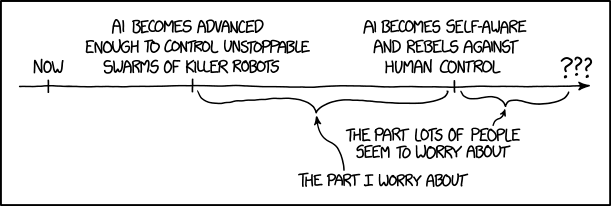
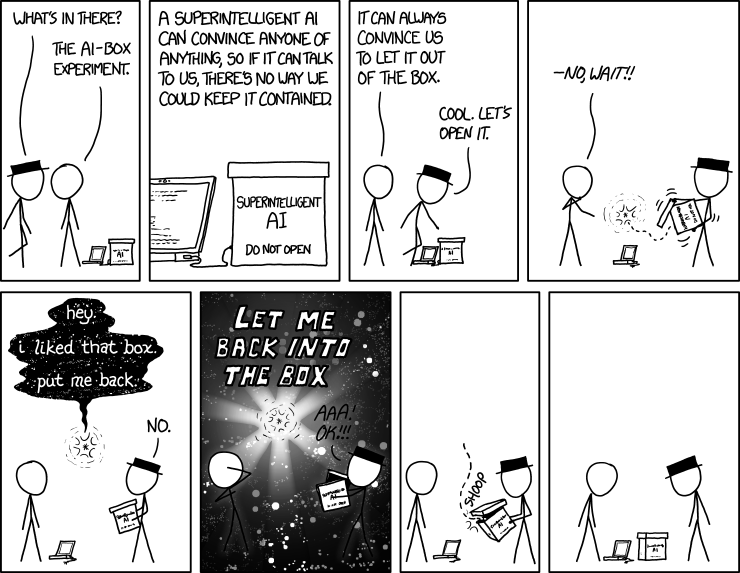
- xkcd cartoon post about "The
Paperclip Maximizer" and AI ethics.
- "Why the biggest challenge facing AI is an ethical one,"
by Bryan Lufkin on BBC's Future Now.
- Benevolent artificial intelligence: "AI Uncovers a Potential Treatment for Covid-19 Patients."
- Singularity Hub article, "This One Equation May Be the Root of Intelligence."
- Futurism.com article, "New AI That Detects 'Deception' May Bring End to Lying as We Know It."
- NPR story, "Weighing The Good And The Bad Of Autonomous Killer Robots In Battle."
- Wall Street Journal article, "Could
Robots Replace Jurors?"
- Related to that: "'Justice delayed is justice denied': Could AI and Data Science be the answer to India's judicial backlog?"
on LinkedIn.
- National Geographic article: "Us and Them."
- Asimov's SF magazine article, "Welcome
Our Robot Overlords!" by James Patrick Kelly.
- Science News
series on consciousness.
- Ray
Kurzweil's comprehensive website about artificial intelligence.
- Kaila Colbin article (or Spark Lab talk) on
"Technological
Unemployment: The Real Reason This Elephant Chart is Terrifying."
- Wired article, "Does
This Terrifying Robot Really Have to Look Like a Mermaid?"
- Rolling Stone article,
"Inside the Artificial Intelligence Revolution: A Special Report,"
(Part 1) and
Part 2.
- Futurism.com article, "Google's
Artificial Intelligence Beats the World Champion of Go
for the Second Time."
- The
Encyclopedia of SF's "Androids"
entry.
- Adbusters article, “The
Artistic Lives of Machines.”
- Kansas City Star's article, "'Chappie'
and other movies ask: Should we be afraid of artificial intelligence?"
- "Will
Superintelligent AI Ignore Humans Instead of Destroying Us?" by
Jason Koebler (in response to Zelijko Svedic's "Singularity
and the anthropocentric bias").
- Future of Life Institute's website. Their motto: "Technology
has given life the opportunity to flourish like never before... or to self-destruct."
- "Where machines could replace humans - and where they can't (yet)," by McKinsey and Company.
- CNET piece, "Deepfakes may ruin the world.
And they can come for you, too." Tech made national news with the
@deeptomcruise TikTok.
Short fiction
- Robin Wayne Bailey's story, "Keepers of Earth."
- Bunker's "They Have All One Breath."
- Greg Egan's "The Discrete Charm of the Turing Machine."
- Lisa Goldstein's story, "Paradise is a Walled Garden."
- C.L. Moore's story, "No Woman Born."
- Alastair Reynolds' story, "Weather."
- Richards' "Operators."
- "Maneki Neko," by Bruce Sterling (ref in "Cat
Pictures Please").
- Jack Williamson's, "With Folded Hands" - the original
robot-laws-gone-amuck story.
Novels and books
- AI 2041,
by Chen Qiufan and Kai-Fu Lee - a collection of ten "scientific fiction"
stories that explore a future defined by artificial intelligence in the near
future just before the Technological Singularity.
-
Ancillary Justice
series, by Ann Leckie.
- Béte, by Adam Roberts.
- The Caves of Steel, by Isaac Asimov.
- Do Androids Dream of Electric Sheep?
by Philip K Dick (the novella
Blade Runner was based on).
- Lock In: A Novel of the Near Future, by John Scalzi.
-
Old Man's War, by John Scalzi.
- The Red
series, including First Light and
Going Dark, by Linda Nagata.
- Robopocalypse, by Daniel H. Wilson.
- The Windup Girl, by Paolo Bacigalupi.
- WWW: Wake, by Robert J. Sawyer.
-
Y the Last Man, by Brian K. Vaughan and Pia Guerra (Vertigo graphic novel series,
now a live-action series).
-
- Some that appear in Bonus! throughout:
The Age of Spiritual Machines, by Ray Kurzweil (also available
as a
free .pdf);
Accelerando, by Charles Stross (available to
read free on Stross' website);
Neuromancer, by William Gibson; and
Rapture of the Nerds (2012), by Cory Doctorow and Charles
Stross (also
free online at Stross' website).
Movies and shows
- Altered Carbon, a Netflix original show (based
on the Richard K. Morgan
novel).
-
Battlestar Galactica.
- Pretty much any episode of the Netflix original series,
Black Mirror.
-
Big Hero 6 (2014).
-
Blade Runner (any of the five 1983 versions) or
Blade Runner 2049 (2017).
- Chappie
(Neill Blomkamp's movie about a child AI).
-
Cowboy Bebop, the 1990s cyberpunk-ey,
space-cowboy anime series.
- The
DYNAMO series of short, brilliant, amateur videos;
Episode 1 is only 14 minutes.
-
Ex Machina (2015) - a must-watch for considering possible AI
futures.
-
Her (2013) -
what if our device operating systems are AIs?
- The "Data's Dreams" episode of
Star Trek: The Next Generation.
- Interstellar (for the TARS 'bots).
-
Johnny Mnemonic (based on William Gibson's
short story - which you can read online here).
-
Picard series (2020-now), especially the episodes about synthetic
life (the core of the show's narrative).
- An episode of
The Sarah Connor Chronicles (great spinoff in the
Terminator universe).
- Any
Terminator movie.
- Netflix original show,
Westworld.
- CRACKED "After Hours" short film,
"Why The Scariest
Sci-Fi Robot Uprising Has Already Begun."
- Person of Interest
excerpt, "Admin is not Admin."
-
Y the Last Man series (2022-), based on the graphic novel.
Multimedia
- Janelle Monáe's brilliant, short (48-minute) musical movie,
Dirty Computer.
- "Neural Karaoke: A Computer Wrote A Christmas Carol That May Haunt You"
video (and story) on NPR.
- "Machine Made," a gallery of robot art.
- Motherboard's 30-minute video, "Inhumankind: The Dawn of Killer Robots."
- "Robots
(Humans are Dead)" humorous music video.
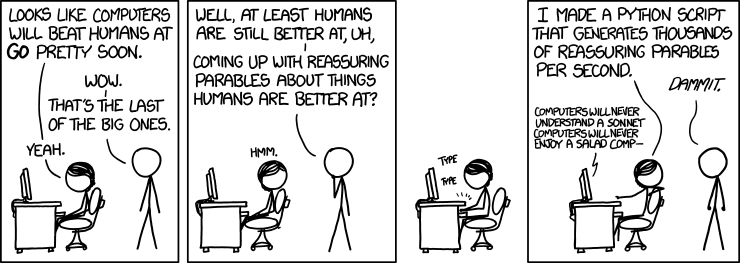
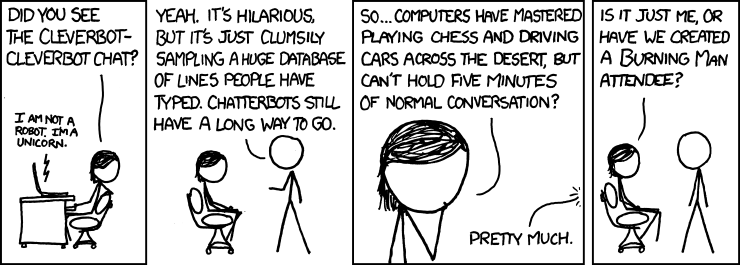
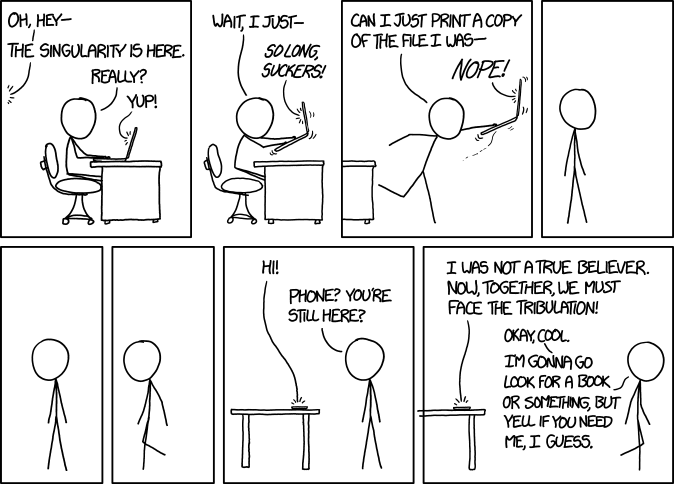
- Thoughtful fun: xkcd's take on AI vs. human intelligence (don't forget to hover your
mouse over the comics to see the full narrative).
- Robot state of the art:
Boston Dynamics' Atlas.
- "Robot
Companions: A New Breed of Social Machines" infographic.
- Short video, "AI Might Run the World Better Than Humans Do."
- Short Big Think video, "Unchecked AI Will Bring On Human Extinction, with Michael Vassar."
- Another short Big Think video, "Michio Kaku: How to Stop Robots From Killing Us."
- Check out the recent AI conference held in NYC, "Ethics
of Artificial Intelligence." They recorded the whole
thing. You can watch it here.
- Robots in space! R2, NASA's
robonaut.
- Thoughtful fun:
xkcd's take on AI vs. human intelligence (don't forget to hover your mouse over the
comics to see the full narrative).
- Robot state of the art:
Boston
Dynamics' Atlas.
- Check out the
functional $1 million
battlemech for sale on Amazon.
- "The Last Bastion"
video.
- "Where machines could replace humans
- and where they can't (yet)" infographic (pdf), by McKinsey and Company.
- The "Social Robotics: Breathing Life into Machines" website. They host a conference every year!
- Search the TED Talk website for a huge assortment of relevant short talks.
- Check out McKitterick's "Sci, Tech, & Society"
YouTube playlist for more, especially the
Robots & Androids and
Artificial Intelligence playlists. Lots of fantastic short films!
Relevant curated playlists
of short SF films on McKitterick's YouTube channel:
Artificial intelligence |
Cyberpunk and cybernetics |
Robots and androids |
The Technological Singularity
Relevant tags on McKitterick's curated Tumblr blog:
AI |
Animal
intelligence |
Artificial
intelligence |
Chatbots |
Computers |
Consciousness
| Cyberpunk
| Cyberpunk dystopia
| Cyberpunk dystopias |
Robots |
Sentience |
Technological Singularity |
the Singularity |
the Technological Singularity |
The
brain |
The
mind
Response Notes
Prior to each discussion session, write a
short (I've found 300 words or so is plenty, about one page) response.
These notes are an important
way to read critically, retain what you've learned, and help engage with the topics,
and you'll likely find yourself writing story ideas during this process. I've heard from former students that they find these
very useful for future reference - several use them for classes they teach! - so hang on to them.
These are brief but thoughtful responses
to all of the assigned materials for the week:
- For the fiction, provide thoughts on
the assigned works in terms of theme, ideas, character, story, setting, artistic
qualities, position in the SF canon, influence on other works, use of the
various media forms, comparisons to the original print texts (if appropriate),
and so forth. What makes this story / show / movie effective (or not)? What
techniques and other writerly aspects can
you
steal borrow
to improve your own writing?
- For the nonfiction, what did you learn, what questions does the
material raise, and how did the material inspire you?
Don't just provide a narrative
summary (though studying plot and narrative structure is useful). Strive for insightful, critical, and thoughtful reflections on
all the works, including how we can learn artistically from them. Articulate how the various storytelling media affect the pieces under
consideration - artistically, narratively, visually, in the social context, and
so on - and how the affect your understanding of AI, the genre of
speculative fiction, and the various media
forms, and how they inspire your writing.
Exercise your critical-reading, -listening, and
-viewing skills when writing these responses; that is, don't just read the fiction,
watch the shows, or otherwise interact with the content simply for pleasure - and don't just accept everything
that scholars and critics have written about them as canon. We want to hear how
you synthesize
new ideas from the materials and your own experiences. The best way to do a good job here is to
take notes as you're reading or watching or listening, then
expand upon those notes for the papers.
Regarding format: Many people use bullets for discussion points, bold the
titles of the works you're discussing, or use the titles as headings.
Some people write responses that resemble essays, citing the works in tandem, while others
merely respond to each individually.
However you prefer to handle it is fine - you're not being graded and no one
needs to see these! - but what's most important is that you've thought through all the
works for each discussion and how they inform your understanding of spec-fic
writing and artificial intelligence - and of course the human condition.
Tip: Include at least a couple of questions to pose to the class or
points to stimulate discussion. I suggest having these handy - especially your
questions - to help formulate ideas during discussion.
Discussions
Starting October 18 (when yours truly returns from our wedding trip!), we'll hold
weekly live and asychronous discussions of the
assigned reading and viewing materials, as well as other things folks check out (see the massive list of recommended stuff).
We'll hold our discussions in Discord (and in-person if enough locals want to gather), and I'm sure we'll continue our discussions
asychronously in our Discord channel. We'll discuss both topical nonfiction and
fiction and writing-related
topics.
Your instructor will help direct these discussions and ensure we're all
considering how these ideas will affect our writing and our world. Please have your response notes handy, and for best discussion please
also bring at least a few questions that come up for you that help prompt further discussion
(or how you disagree, and so forth) and help everyone get thinking more
deeply about the topics.
I love group discussions like this, because working together we can
transcend the level of thought any one person is capable of, becoming a sort
of super-mind without any assistance from AI. As Theodore Sturgeon put it,
More Than Human.
Be civil: These are discussions about ideas, not arguments! Civility and respect for the opinions of others are
vital for a free exchange of ideas. You might not agree with everything I or
others say in the classroom, but I expect respectful behavior and interaction all times. When you disagree with someone, make a distinction between
criticizing an idea and criticizing the person. Similarly,
try to remember that discussions can become heated, so if someone seems to be
attacking you, keep in mind they take issue with your idea, not who
you are, and respond appropriately. Expressions or actions that disparage a person's
age, culture, disability, ethnicity, gender, gender identity or expression,
nationality, race, religion, or sexual orientation - or their marital, parental, or veteran status
- are contrary to the mission of this course and will not be tolerated. And of
course please try not to dominate the conversation while encouraging more-shy
participants to join in. If we
all strive to be decent human beings, we'll get the most out of this course!
"Science into Fiction" Spec-Fic Writing Workshops:
Series 1: "The Higgs Boson in This Particular Universe"
Series 2: "Creativity and the Brain"
Series 3: "Writing in (and about) the Age of Artificial Intelligence"
Series 4: "Six great stories and what makes them work: The science of SF writing"
Series 5: "Writing Spec-Fic Humor" coming Fall 2026:
apply Summer 2026
Chris McKitterick's Spec-Fic Writing Workshop & Repeat Offenders Workshop
Kij Johnson & Barbara Webb's SF&F Novel Writing Workshops and Masterclasses
Speculative-fiction writing resources
Scholarships
Connect with Ad Astra






We believe strongly in the free sharing of information, so you'll find a lot of content - including course syllabi
and many materials from our classes - on this and related sites and social
networks as educational outreach. Feel free to use this content for independent
study, or to adapt it for your own educational and nonprofit purposes; just
please credit us and link back to this website. We'd also love to hear from you
if you used our materials!
This site is associated with the Science Fiction and Fantasy
Writers of America (SFWA), the Science Fiction Research Association
(SFRA), AboutSF, and other organizations, and its contents are copyright 1992-present
Christopher McKitterick
except where noted, and licensed under a
Creative Commons Attribution-NonCommercial-ShareAlike 4.0 International License: Feel free to use and adapt for non-profit purposes, with attribution. For publication or profit purposes, please contact
McKitterick
or other creators as noted.
This site does not use cookies and is free from tracking. We
do not use or condone the use of machine-generated text or images for
educational or creative purposes (except as satire), and do not accept student or teacher work
manufactured by algorithms.

Works on this site are licensed under a Creative
Commons Attribution-NonCommercial-ShareAlike 4.0 International License.
updated 9/2/2025


We believe strongly in the free sharing of information, so you'll find a lot of content - including course syllabi and many materials from our classes - on this and related sites and social networks as educational outreach. Feel free to use this content for independent study, or to adapt it for your own educational and nonprofit purposes; just please credit us and link back to this website. We'd also love to hear from you if you used our materials!
This site is associated with the Science Fiction and Fantasy Writers of America (SFWA), the Science Fiction Research Association (SFRA), AboutSF, and other organizations, and its contents are copyright 1992-present Christopher McKitterick except where noted, and licensed under a Creative Commons Attribution-NonCommercial-ShareAlike 4.0 International License: Feel free to use and adapt for non-profit purposes, with attribution. For publication or profit purposes, please contact McKitterick or other creators as noted.
This site does not use cookies and is free from tracking. We do not use or condone the use of machine-generated text or images for educational or creative purposes (except as satire), and do not accept student or teacher work manufactured by algorithms.
Works on this site are licensed under a Creative Commons Attribution-NonCommercial-ShareAlike 4.0 International License.
updated 9/2/2025